
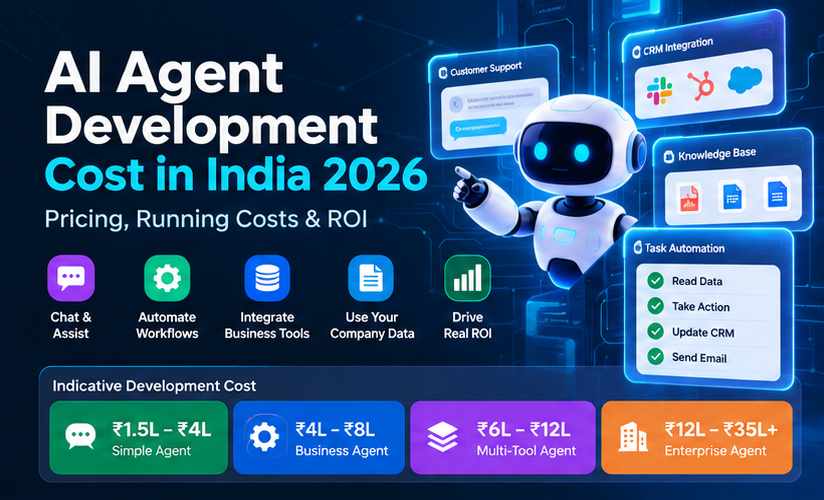
# AI Agent Development Cost in India 2026: Pricing, Running Costs & ROI
How much does it cost to build an AI agent in India in 2026?
For initial planning, a focused single-workflow AI agent may cost roughly ₹1.5 lakh to ₹4 lakh, a production agent integrated with business systems can fall around ₹4 lakh to ₹12 lakh, while sophisticated multi-agent or enterprise implementations can move beyond ₹12 lakh to ₹35 lakh+.
These are broad planning ranges rather than fixed quotations.
The actual cost depends on what the AI agent is allowed to do.
An agent that answers questions from company documents is substantially simpler than an agent that reads customer information, connects with a CRM, creates quotations, updates orders, sends emails and requests human approval before performing sensitive actions.
AI Agent Development Cost in India: Quick Answer
| AI Agent Type | Indicative Development Cost | Typical Use |
|---|---:|---|
| Simple AI assistant | ₹1.5L–₹4L | FAQ, document search, internal knowledge |
| Business workflow agent | ₹4L–₹8L | CRM actions, lead qualification, reporting |
| Multi-tool AI agent | ₹6L–₹12L | APIs, databases, email, workflow automation |
| Multi-agent platform | ₹12L–₹35L+ | Multiple specialized agents working together |
| Enterprise agentic system | Scope dependent | Governance, SSO, audits, security, high scale |
A business should therefore avoid asking only:
"How much does an AI agent cost?"
The better question is:
"Which business process should the agent complete from beginning to end?"
---
What Is an AI Agent?
An AI agent is software that uses an AI model to understand an objective, reason about what should happen next, retrieve information and interact with tools or systems.
A conventional chatbot might answer:
"What is your refund policy?"
An AI agent may be able to:
- Identify the customer.
- Retrieve the relevant order.
- Check the refund rules.
- Determine whether the request is eligible.
- Ask for human approval if necessary.
- Update the CRM or support system.
- Send the customer a response.
- Record the action for auditing.
That ability to combine AI reasoning with software tools is what makes agent development more complex than implementing a normal chatbot.
---
What Determines AI Agent Development Cost?
1. Number of Workflows
One narrow workflow is cheaper than an agent expected to perform twenty different jobs.
For example, an agent that qualifies inbound leads may need to:
- read enquiry information;
- ask qualifying questions;
- score the lead;
- update the CRM;
- assign the correct salesperson;
- schedule follow-up.
Even that single workflow may touch several systems.
2. Number of Integrations
AI becomes much more valuable when it can interact with business systems.
Common integrations include:
- CRM;
- ERP;
- email;
- WhatsApp;
- databases;
- helpdesk software;
- ecommerce platforms;
- payment systems;
- calendars;
- document storage;
- internal APIs.
Every integration introduces authentication, permissions, error handling and monitoring requirements.
3. RAG and Private Company Knowledge
Many business AI systems use Retrieval-Augmented Generation, or RAG.
Instead of depending entirely on what an AI model already knows, the system retrieves relevant information from your own approved documents or databases before answering.
A production RAG architecture may contain:
Documents → Parsing → Chunking → Embeddings → Vector Search → Re-ranking → LLM → Answer
The engineering challenge is not merely storing documents.
You also need to handle document updates, permissions, retrieval quality, citations, duplicate information and information the user should not be allowed to see.
Learn more about Zenvira's approach to AI Agents & Automation.
---
AI Agent Development Cost by Complexity
Basic Knowledge Agent — ₹1.5L to ₹4L
Typical scope:
- web chat interface;
- company-document search;
- basic RAG;
- limited conversation history;
- analytics;
- basic administration;
- one AI provider.
This can be suitable for internal knowledge or focused customer-support scenarios.
Integrated Business Agent — ₹4L to ₹8L
Typical scope:
- RAG;
- CRM integration;
- APIs;
- authentication;
- lead qualification;
- structured outputs;
- business rules;
- dashboards;
- human escalation.
This type of project usually creates more measurable operational value because the agent can perform actions rather than simply answer questions.
Multi-Tool Agent — ₹6L to ₹12L
A multi-tool system may connect with:
- CRM;
- email;
- calendar;
- database;
- payment platform;
- document system;
- analytics.
The AI needs to decide which tool to use and when.
This requires stronger guardrails and extensive testing.
Multi-Agent Platform — ₹12L to ₹35L+
A multi-agent architecture contains specialized agents responsible for different functions.
For example:
Customer Request
↓
Coordinator Agent
↓
Sales Agent | Support Agent | Finance Agent | Operations Agent
↓
Human Approval
↓
Business Systems
This architecture may be appropriate when several departments or complex workflows are involved.
---
What Does It Cost to Run an AI Agent Every Month?
Development is only the initial expense.
Production AI agents can also incur recurring costs for:
- LLM API usage;
- embeddings;
- vector databases;
- cloud infrastructure;
- observability;
- logs;
- document processing;
- external APIs;
- monitoring;
- ongoing engineering.
For smaller deployments, operating costs may remain relatively modest.
For high-volume systems processing thousands of conversations, large documents or expensive models, monthly costs can increase considerably.
The important metric is therefore not simply:
Cost per AI response.
It is:
Cost per successfully completed business outcome.
---
How to Reduce AI Agent Running Costs
Use Different Models for Different Tasks
The most powerful model does not need to perform every operation.
A smaller model may be perfectly adequate for:
- classification;
- extraction;
- routing;
- summarization;
- formatting.
Higher-capability models can then be reserved for tasks requiring more complex reasoning.
Cache Repeated Information
If users repeatedly request the same information, caching can reduce unnecessary AI calls.
Limit Context Size
Sending huge documents to the model for every request wastes tokens.
Strong retrieval should return only the most relevant information.
Monitor Every Agent
Track:
- token consumption;
- response time;
- task success;
- failed tool calls;
- human interventions;
- hallucination rate;
- cost per workflow.
Without observability, AI costs can grow without creating equivalent business value.
---
Human-in-the-Loop AI Agents
A production agent should not automatically receive unlimited permission.
High-risk actions should require human approval.
Examples include:
- issuing refunds;
- changing prices;
- deleting records;
- sending contracts;
- approving financial transactions;
- modifying user permissions.
A safer architecture looks like:
AI proposes action → Business rules validate → Human approves → System executes
Zenvira's AI Agents & Automation engineering uses human-approved guardrails for workflows where autonomous actions could have material consequences.
---
AI Agent vs AI Chatbot
| Capability | Chatbot | AI Agent |
|---|---|---|
| Answers questions | Yes | Yes |
| Searches company knowledge | Sometimes | Yes |
| Uses external software | Limited | Yes |
| Executes multi-step tasks | Usually no | Yes |
| Maintains workflow state | Limited | Yes |
| Makes tool decisions | Usually no | Yes |
| Human approval workflows | Rare | Recommended |
If all you need is customer FAQ functionality, building an advanced autonomous agent may be unnecessary.
The technology should match the business problem.
---
How Long Does AI Agent Development Take?
A focused prototype may take several weeks.
A production system requiring RAG, authentication, multiple integrations, dashboards, security and evaluation generally takes longer.
A reasonable delivery process includes:
Discovery
Document the workflow and define exactly which decisions belong to the AI.
Prototype
Test whether the selected model can reliably perform the core task.
Integration
Connect the AI with approved company systems.
Evaluation
Create test datasets and measure accuracy.
Guardrails
Define permissions, limits and human-approval requirements.
Production
Deploy monitoring, logs and cost controls.
---
Hidden AI Agent Costs Businesses Miss
Businesses should also budget for:
- document cleanup;
- API development;
- data migration;
- integration work;
- AI evaluations;
- security testing;
- ongoing prompt improvements;
- monitoring;
- model changes;
- employee training.
An AI prototype that works in a controlled demonstration is not automatically ready for real customers.
Production reliability requires engineering around the model.
---
How to Calculate AI Agent ROI
Suppose employees currently perform a repetitive process 1,500 times every month.
If each process takes five minutes, that represents:
1,500 × 5 minutes = 7,500 minutes
That equals approximately:
125 hours per month
If an AI workflow safely automates 70% of those cases, approximately 87.5 hours of repetitive work could be removed or redirected.
Then compare:
Monthly financial/time value created
against:
Monthly AI + infrastructure + maintenance cost
That is more useful than measuring how impressive the chatbot appears.
---
What Businesses Should Build AI Agents First?
Good first candidates tend to have workflows that are:
- repetitive;
- measurable;
- high volume;
- clearly defined;
- dependent on existing digital information;
- reversible if something goes wrong.
Examples include:
- inbound lead qualification;
- support triage;
- knowledge search;
- invoice extraction;
- document classification;
- reporting;
- CRM updates;
- meeting follow-up.
Avoid beginning with highly sensitive processes where one incorrect decision could cause substantial harm.
---
How Zenvira Approaches AI Agent Development
At Zenvira Softech, production AI architecture focuses on more than connecting an LLM API.
Our AI engineering work considers:
- contextual RAG;
- vector databases;
- permission-aware retrieval;
- API integrations;
- audit trails;
- human-in-the-loop approvals;
- cost monitoring;
- evaluation systems;
- secure business workflows.
Explore our AI Agents & Automation service or view Zenvira's projects and engineering roadmap.
---
Frequently Asked Questions
How much does an AI agent cost in India?
A focused AI agent may start around a few lakh rupees, while multi-tool or enterprise agent systems can require considerably larger budgets. Scope, integrations and security requirements determine the final cost.
Is an AI agent more expensive than a chatbot?
Usually yes. An AI agent can interact with tools and execute workflows, which requires additional engineering, security and testing.
Does an AI agent require a custom AI model?
Not necessarily. Many production systems use commercial foundation models combined with RAG, business rules and custom integrations.
What is the biggest hidden cost?
Integration and production reliability are frequently underestimated. Connecting AI safely to real business systems often requires more work than the conversational interface itself.
Can AI agents replace employees?
AI agents are best viewed as workflow automation systems. Human oversight remains important for exceptions, relationships, judgment and sensitive decisions.
---
Final Takeaway
AI agent development cost in India in 2026 depends less on the chatbot interface and more on what the system is trusted to accomplish.
A narrow knowledge assistant may cost a few lakh rupees.
A production AI agent interacting with CRMs, databases and workflows requires considerably more architecture, testing and security.
Before asking for an AI-agent quotation, define:
one workflow, one measurable outcome and the systems the agent must use.
That produces a much more accurate estimate.
Planning an AI workflow for your company?