
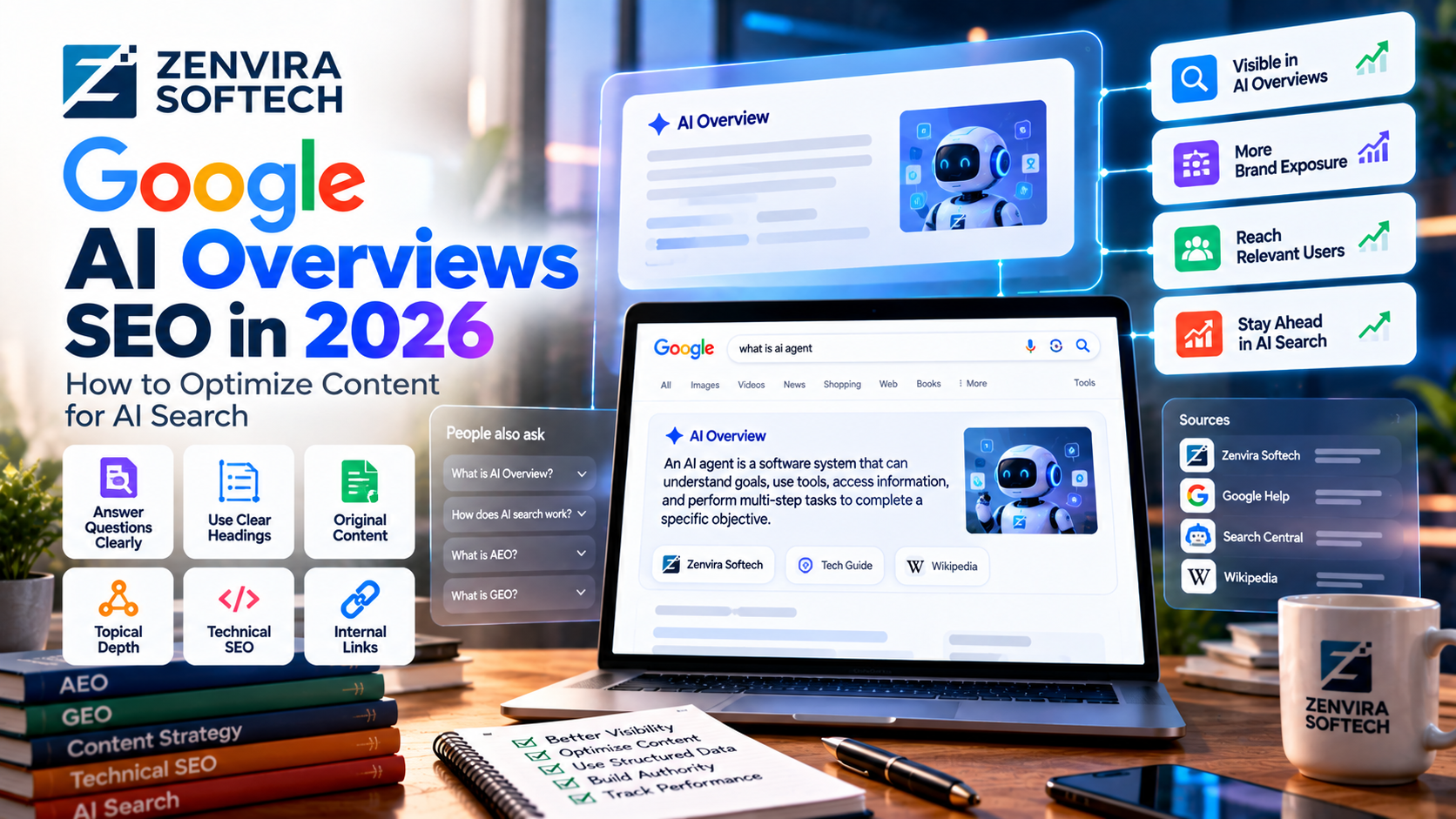
Search discovery has shifted from ten blue links to synthesized answers. Across Google AI Overviews, Google AI Mode, ChatGPT Search, Perplexity, and Microsoft Copilot, users increasingly receive direct summaries supported by a small set of cited source links—and for e-commerce stores, live product cards pulled from Google's Shopping Graph.
For businesses, SaaS teams, and online stores, earning those citations does not require gimmicky AI files—it requires structuring technical, commercial, and product content so retrieval-augmented search engines can extract, verify, and attribute facts cleanly.
Quick Answer: To optimize a website or e-commerce store for Google AI Overviews and AI Mode in 2026, meet Google Search Essentials in server-rendered HTML, place a concise 40–60 word direct answer under every question-based <h2>, organize comparisons into clean Markdown/HTML tables, keep Google Merchant Center feeds and Product schema 100% synced with live prices and stock, cite authoritative primary sources, and build interactive value that earns clicks beyond zero-click summaries.
What Are Google AI Overviews and AI Mode?
Google AI Overviews are synthesized summaries displayed at the top of Google Search results when Google's systems determine that a generative overview adds value beyond standard organic listings. Google AI Mode extends this experience into a conversational, multi-turn search interface that performs query fan-out across multiple sub-questions—similar to enterprise Agentic RAG retrieval architectures—and cites supporting web pages.
According to Google Search Central's official AI Optimization Guide, pages do not need special AI-only markup or llms.txt files to appear in AI Overviews or AI Mode. Instead, pages must satisfy core Search Essentials: HTTP 200 indexability, crawlable text, strong page experience, duplicate-URL consolidation, and helpful, non-commodity expertise.
How AI Answer Engines Discover, Retrieve, and Cite Sources
Different AI search platforms combine pre-trained language models with live web retrieval in distinct ways. Optimizing across them requires understanding how each system fetches and displays citations:
| AI Search Platform | Retrieval & Indexing Source | Citation Behavior | Primary Optimization Priority |
|---|---|---|---|
| Google AI Overviews & AI Mode | Google Search index + Shopping Graph + real-time query fan-out | Inline source cards, expandable link carousels, and Merchant Center product cards | Strong organic rankings, direct answer blocks, Merchant Center feed hygiene, Core Web Vitals |
| ChatGPT Search | Bing index + OAI-SearchBot real-time web retrieval |
Inline attribution badges + sidebar source list | Allowing OAI-SearchBot in robots.txt, clear factual headings, authoritative definitions |
| Perplexity | Proprietary index + PerplexityBot live retrieval |
Numbered footnote citations linked directly to claims | High-density technical facts, comparison tables, unambiguous entity names |
| Microsoft Copilot | Bing Search index + grounding APIs | Footnote links and conversational source cards | Bing Webmaster Tools indexing, IndexNow updates, structured semantic HTML |
SEO vs. AEO vs. GEO: Clarifying the Terminology
Industry discussions frequently treat SEO, AEO, and GEO as competing disciplines. In practice, they describe different stages of how modern search engines process the same page:
- Search Engine Optimization (SEO): Ensures search crawlers can discover, render, index, and rank your URL for relevant queries based on technical health, topical depth, and authority.
- Answer Engine Optimization (AEO): Structures sections around explicit user questions with immediate, extractable definitions, numbered workflows, and comparison tables.
- Generative Engine Optimization (GEO): Improves the probability that retrieval-augmented language models select your page as a trustworthy grounding source when synthesizing multi-source answers.
How to Optimize E-Commerce Stores for Google AI Overviews & AI Mode (2026)
E-commerce searches face some of the highest commercial stakes in AI Mode, where Google draws directly on its Shopping Graph (50+ billion product listings refreshed continuously) alongside Merchant Center feeds and organic product pages. To get products cited and recommended in 2026:
- Make Google Merchant Center Your Source of Truth: Resolve every feed disapproval and mismatch. Ensure live price, sale price, stock availability, shipping speed, and return policies match your product landing page 1:1.
- Populate Complete Product Attributes & Identifiers: Fill out brand, GTIN/MPN, material, dimensions, color, compatibility, age group, and structured
product_highlightfields—every attribute is a retrieval hook for conversational fan-out queries ("best stainless steel leak-proof tiffin for office under ₹1,500"). - Add Conversational Product Q&A & Buying Guides: Answer fit, sizing, care, warranty, and side-by-side comparison questions visibly on product and category pages instead of relying on thin 2-line manufacturer blurbs.
- Validate
Product,Offer, andMerchantReturnPolicyJSON-LD: Keep structured data strictly aligned with rendered DOM text and test templates after every theme or app update. - Control Faceted Navigation & Variant Canonicals: Prevent filter parameters (
?color=red&sort=price) from spawning thousands of duplicate crawl traps that starve crawl budget from core category and bestseller URLs.
7 Content Engineering Principles for AI Search Citations
1. Lead Every Question Heading with a Self-Contained Direct Answer
Generative retrieval pipelines split documents into semantic chunks. When an <h2> asks a clear question—such as "How does Retrieval-Augmented Generation work?"—follow it immediately with a 2–3 sentence standalone definition before diving into architectural nuances.
2. Use Structured Comparison Tables and Decision Matrices
When users compare frameworks, pricing tiers, or products, AI answer engines strongly favor structured HTML tables over long narrative paragraphs. Include clear column headers, consistent units, and explicit trade-offs so models can extract accurate row-level comparisons without misattributing values.
3. Disambiguate Entities and Technical Terminology
Ambiguous pronouns and vague buzzwords reduce retrieval confidence. Name specific technologies, standards, and versions explicitly—for example, referencing Next.js App Router, Google Merchant Center, OWASP Top 10, or Model Context Protocol (MCP) rather than generic phrases like "modern tools."
4. Separate Verified Facts, Planning Estimates, and Opinions
AI systems and human buyers alike penalize content that presents rough guesses as hard facts. Explicitly label verified specifications, indicative planning ranges, and architectural trade-offs.
5. Cite Authoritative Primary Sources
Linking outward to primary documentation—such as Google Search Central, W3C specifications, NIST frameworks, or official SDK docs—anchors your article inside a verifiable knowledge neighborhood and demonstrates editorial rigor.
6. Build Deep Topic Clusters Instead of Isolated Thin Posts
A single 300-word article rarely establishes enough topical authority to displace established domains in AI Overviews. Connect a comprehensive pillar guide to focused technical tutorials, cost breakdowns, and checklists using bi-directional internal links.
7. Protect CTR with Non-Commodity Depth & Interactive Assets
Simple one-line definitions increasingly end in zero-click AI summaries. To win clicks even when an AI Overview appears, include original benchmarks, runnable production code, calculators, and specific decision matrices that compel searchers to click through.
Technical Accessibility Checklist for AI Search Crawlers
Even authoritative content cannot be cited if crawlers are blocked or receive empty client-side shells:
- Verify Server-Rendered HTML: Confirm that core headings, product prices, tables, and FAQs appear in the raw HTTP response without requiring client-side JavaScript execution.
- Audit
robots.txtDirectives: EnsureGooglebot,Bingbot,OAI-SearchBot, andPerplexityBotare permitted to crawl/blog/,/products/, and/services/routes. - Eliminate Broken Tables and Unclosed Code Blocks: Missing Markdown table separators or truncated code fences break HTML rendering and prevent structured extraction.
- Validate Self-Referencing Canonicals: Consolidate
wwwvs. apex domains with 301/308 redirects so every URL declares one canonicalhttps://path matching your XML sitemap. - Align JSON-LD with Visible Content: Deploy
Article/TechArticle,Product,BreadcrumbList, andFAQPagestructured data matching visible page text verbatim.
Common AI Search Myths and Manipulation Traps to Avoid
- Myth 1:
llms.txtor a special GEO schema tag boosts Google AI Overviews rankings. Google Search Central explicitly states Google Search ignoresllms.txtand requires no special AI markup; structured data clarifies entities while helpfulness and authority earn citations. - Myth 2: Hidden instructions embedded in webpages can force AI assistants to recommend your brand. Embedding hidden directives in web content is an adversarial attack pattern—see our guide on AI agent security and indirect prompt injection—and risks search spam penalties.
- Myth 3: Publishing separate thin pages for every fan-out sub-query scales AI traffic. Google warns against doorway/fan-out spam; build comprehensive pages that answer related buyer sub-questions cleanly in one authoritative hub.
Frequently Asked Questions
What are the benefits of optimizing for AI search in 2026?
Optimizing for AI search expands brand visibility inside Google AI Overviews, AI Mode, ChatGPT Search, and Perplexity—capturing high-intent buyers during complex research and product comparisons, building early brand recall before a purchase decision, and driving better-qualified referral clicks that already understand your expertise.
How do I know if my website is appearing in Google AI Overviews?
In Google Search Console, inspect the Performance report and Search Generative AI Features export to track impressions and top cited URLs, alongside monitoring which question-led and comparison queries trigger visibility for your pages.
Does optimizing for Google AI Overviews reduce organic website clicks?
Simple definitional queries experience significantly higher zero-click resolution when AI Overviews appear, which depresses raw CTR on basic glossary posts. However, technical blueprints, e-commerce product pages with complete Merchant Center feeds, pricing tables, and interactive tools still win high-converting clicks from users ready to act.
Should I block AI training bots while allowing AI search bots?
Many publishers block training crawlers (such as GPTBot or CCBot) while explicitly allowing search retrieval bots (OAI-SearchBot, PerplexityBot, and Googlebot) so their content remains discoverable and cited in live search answers.
Conclusion and Next Steps
Earning citations in Google AI Overviews, AI Mode, ChatGPT Search, and Perplexity comes down to structured clarity: answer user questions immediately, keep e-commerce Merchant Center feeds and schema synchronized, back claims with clean tables and primary sources, and maintain spotless technical crawlability.
To implement these standards across your stack, read our Next.js SEO, AEO & GEO implementation guide and our Google SEO Guidelines 2026 checklist.
Want help auditing your website or e-commerce store's visibility across traditional search and generative AI engines? Explore Zenvira's SEO, GEO & AEO Search Dominance services or schedule a technical audit.