
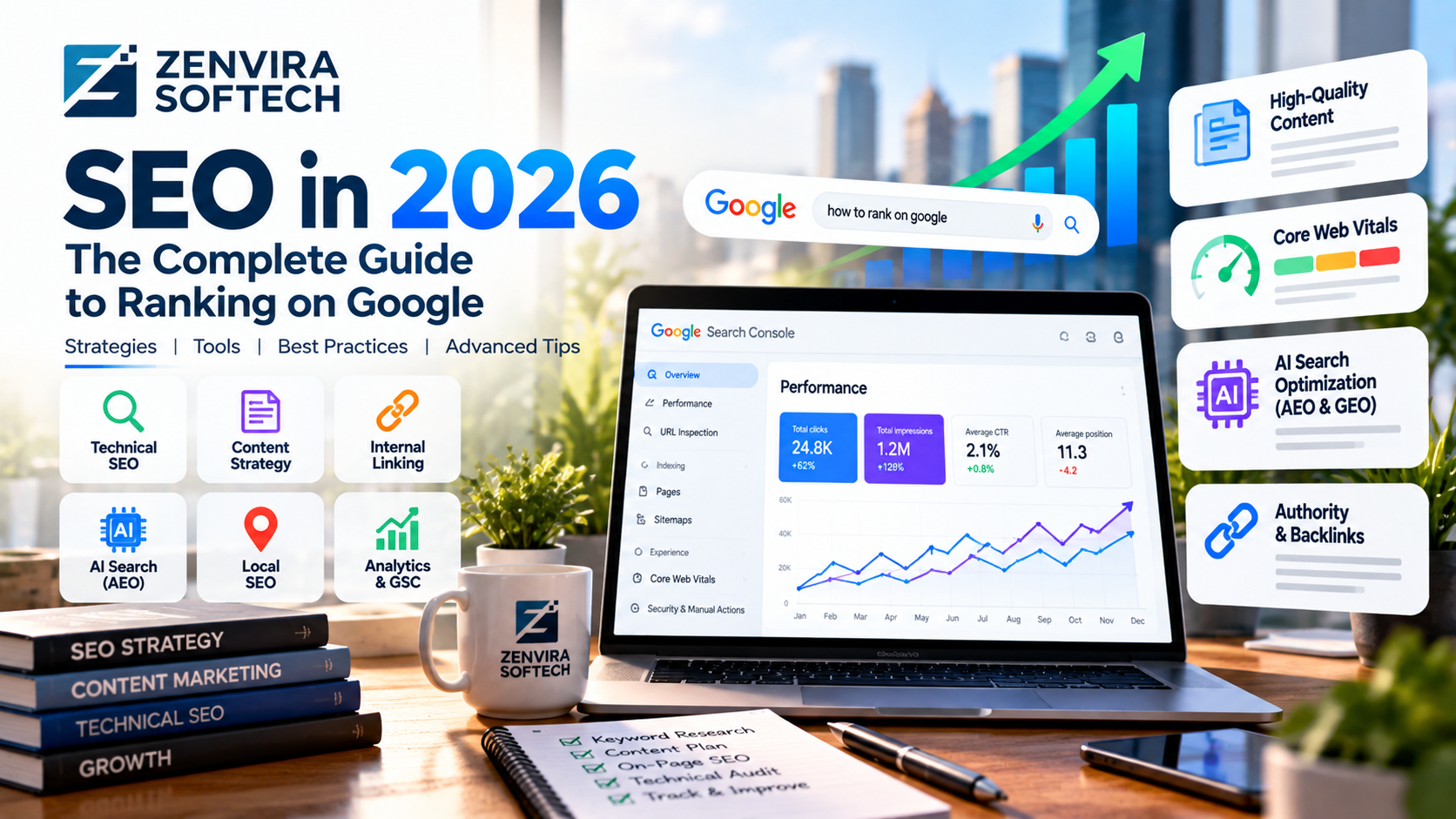
SEO in 2026: The Complete Guide to Ranking on Google
Search engine optimization is no longer just about adding keywords to a page.
Modern SEO combines technical accessibility, useful content, search intent, website performance, internal linking, structured information, authority, and user experience.
Search is also expanding into AI-assisted experiences, making it increasingly important for websites to communicate information clearly.
This guide explains the foundations of SEO in 2026.
What Is SEO?
SEO stands for Search Engine Optimization.
It is the process of improving a website so that search engines can discover, understand, index, and potentially show its pages for relevant searches.
SEO includes three major areas:
- Technical SEO
- On-page SEO
- Off-page and authority signals
How Does Google SEO Work?
Search engines generally need to:
- Discover pages
- Crawl pages
- Understand content
- Index useful pages
- Determine relevance
- Rank results for searches
Your SEO strategy should therefore make every stage easier.
Technical SEO
Technical SEO includes:
- Crawlability
- Indexability
- Site architecture
- Canonical URLs
- XML sitemaps
- Robots configuration
- HTTPS
- Mobile usability
- Page performance
- Structured data
A beautiful article is not very useful if search engines cannot access it correctly.
Search Intent
Before creating an article, determine what the user actually wants.
For example:
"what is SEO"
is informational.
"SEO agency Mumbai"
has local and commercial intent.
"SEO pricing India"
has commercial research intent.
The content should match the purpose behind the query.
Keyword Research
Keyword research helps identify:
- Topics
- Questions
- Search patterns
- Related concepts
- Commercial opportunities
Do not create pages solely because a keyword has a large search volume.
Consider:
- Relevance
- Competition
- Search intent
- Business value
- Ability to create better content
On-Page SEO
Important on-page elements include:
Title
Create a descriptive page title.
H1
Use a clear primary heading.
Headings
Use H2 and H3 headings to organize the page.
Content
Answer the user's question clearly.
Images
Use relevant, optimized images.
Internal Links
Connect related content.
Metadata
Use appropriate titles and descriptions.
Technical SEO Checklist
Before publishing, verify:
- Page returns HTTP 200
- Page is indexable
- Canonical is correct
- Sitemap is updated
- Robots rules are correct
- Internal links work
- Mobile layout works
- HTTPS is active
- Images are optimized
SEO and AI Search
AI-powered search experiences are changing how users discover information.
This creates related strategies such as:
- AEO
- GEO
- AI search optimization
The fundamental principle remains useful content.
Do not create pages only to manipulate AI systems.
Instead:
- Answer questions clearly
- Use descriptive headings
- Provide original information
- Cite reliable sources
- Explain technical concepts
- Add real examples
Internal Linking
Internal links help users move through related content.
A strong website can have:
Pillar Page
   ↓
Supporting Article
   ↓
Detailed Tutorial
   ↓
Service Page