
AI & Automation2 min readPublished September 29, 2026

AI Agents in 2026: What They Are, How They Work, and How Businesses Can Use Them

AI agents are changing how businesses automate research, customer support, operations, sales, and software workflows. Learn what AI agents are, how they work, how they differ from chatbots, real-world business use cases, implementation architecture, costs, risks, and how to get started.

Z
Zenvira Engineering Team
Engineering, Architecture & Growth
AI Agents in 2026: What They Are, How They Work, and How Businesses Can Use Them

Key Architectural Takeaway

AI agents are changing how businesses automate research, customer support, operations, sales, and software workflows. Learn what AI agents are, how they work, how they differ from chatbots, real-world business use cases, implementation architecture, costs, risks, and how to get started. Explore how Zenvira applies these patterns across our Web Development and AI Agents practices.

# AI Agents in 2026: What They Are, How They Work, and How Businesses Can Use Them

AI is moving beyond simple chatbots.

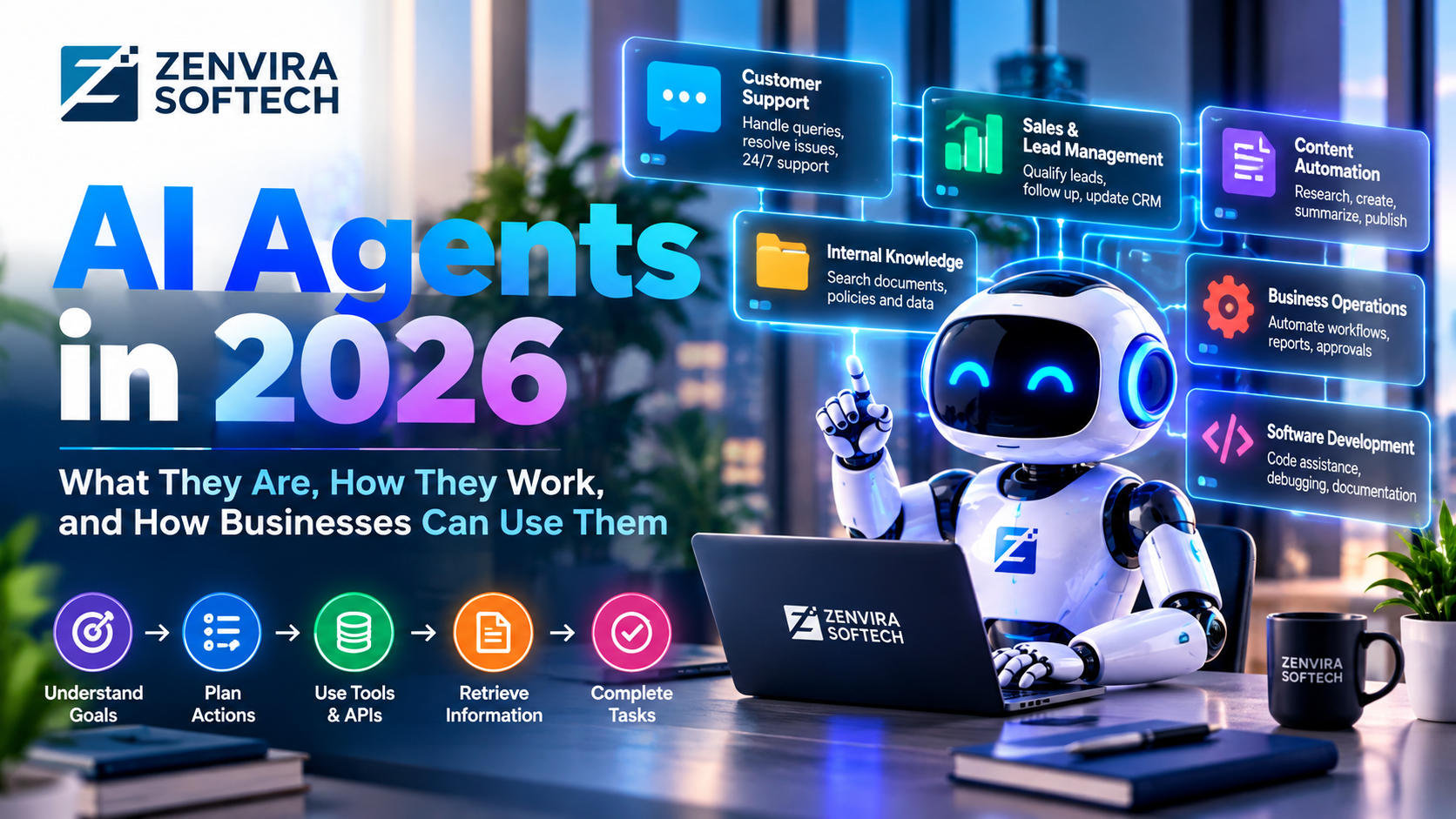
Modern AI systems can increasingly understand goals, reason through tasks, use tools, retrieve information, interact with software, and complete multi-step workflows.

These systems are commonly called AI agents.

For businesses, AI agents can potentially automate repetitive knowledge work across customer support, sales, research, operations, software development, finance, and internal workflows.

This guide explains what AI agents are, how they work, how they differ from traditional chatbots, where businesses can use them, and what it takes to build an AI agent for production.

Quick answer: An AI agent is a software system that uses AI models to interpret a goal, decide what actions are required, use available tools or data, and work through one or more steps to complete a task.

---

What Is an AI Agent?

An AI agent is a software system designed to perform tasks based on a goal rather than simply returning a single response.

A traditional chatbot might answer:

"What is our refund policy?"

An AI agent could potentially:

  1. Understand the customer's request.
  2. Retrieve the customer's order.
  3. Check the applicable refund policy.
  4. Determine whether the order qualifies.
  5. Create a support ticket.
  6. Initiate an approved workflow.
  7. Inform the customer about the result.

The difference is that an agent can combine reasoning with tools and actions.

---

How Do AI Agents Work?

A typical AI agent architecture contains several components:

  • AI model
  • System instructions
  • Memory or conversation state
  • Knowledge retrieval
  • External tools
  • APIs
  • Business rules
  • Authentication
  • Monitoring
  • Human approval mechanisms

A simplified workflow looks like this:

User Goal
   ↓
AI Agent
   ↓
Understand Objective
   ↓
Plan Actions
   ↓
Retrieve Information
   ↓
Use Tools / APIs
   ↓
Evaluate Result
   ↓
Continue or Finish
   ↓
Human / Customer
Tags:AI AgentsArtificial IntelligenceAI AutomationGenerative AIAI DevelopmentAI ChatbotsBusiness AutomationAI EngineeringAI Workflows

Explore Related Disciplines

Need an accountable engineering partner to execute these standards for your business?

All ServicesCase StudiesStart a consultation
Continue Reading

Related Blueprints

Web Development4 min read

Web Development Trends in 2026: 15 Technologies Businesses Should Know

Explore 15 important web development trends shaping modern websites and applications in 2026, including AI integration, Next.js, performance, accessibility, security, cloud infrastructure, headless CMS and modern web architecture.

Read blueprint
AI & Automation4 min read

AI Automation for Small Businesses: 25 Processes You Can Automate in 2026

Discover 25 practical AI automation opportunities for small businesses, including customer support, lead management, content, reporting, scheduling, document processing, sales and internal operations.

Read blueprint