
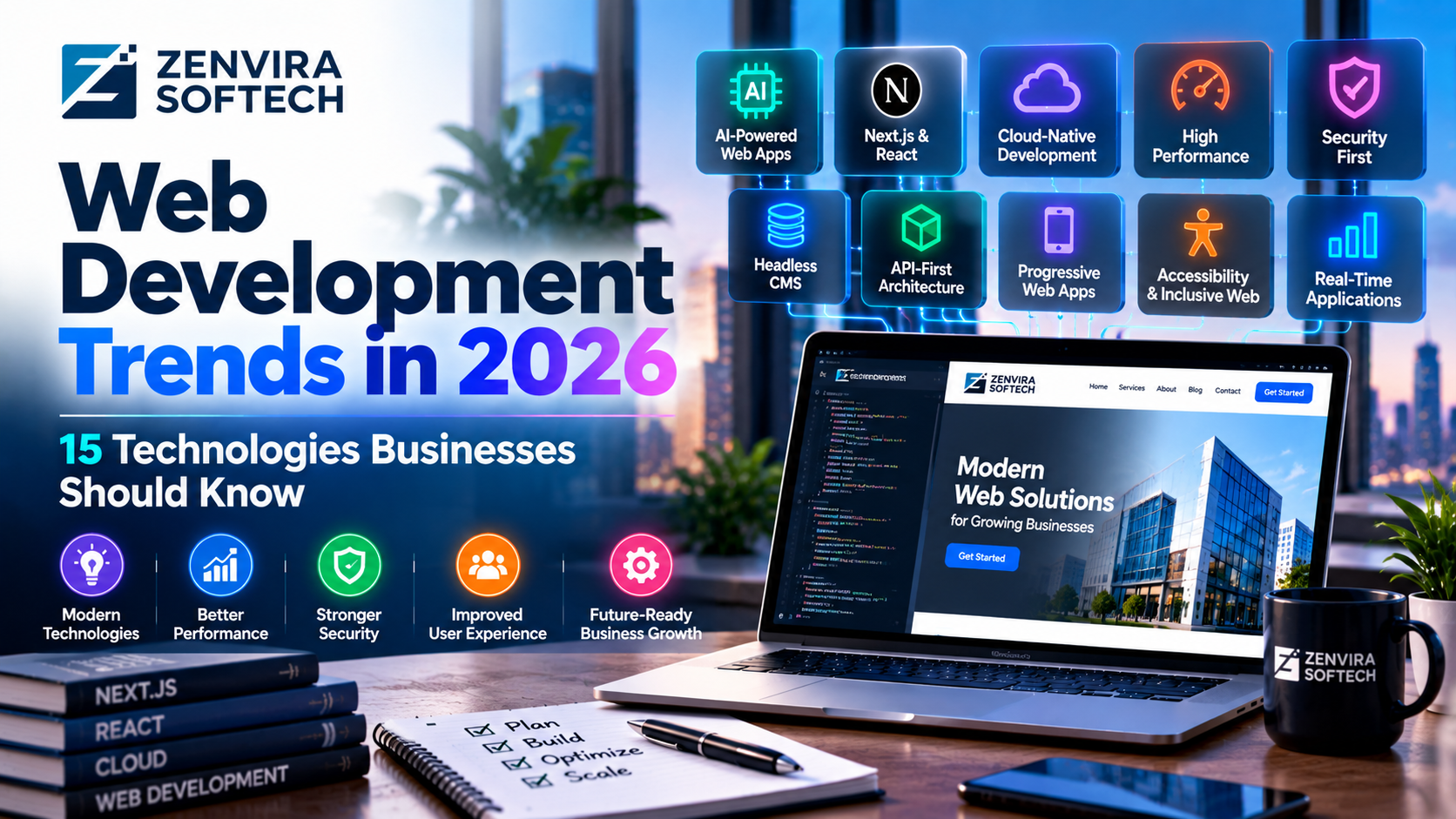
Web Development Trends in 2026: 15 Technologies Businesses Should Know
Web development continues to evolve as businesses demand faster websites, better digital experiences, stronger security, and deeper integration with AI.
In 2026, companies are increasingly evaluating web platforms based not only on visual design but also on performance, scalability, accessibility, search visibility, security, and integration capabilities.
Here are 15 important trends businesses should understand.
1. AI-Powered Web Applications
AI is becoming a component inside traditional web applications.
Examples include:
- AI search
- Recommendation systems
- Customer assistants
- Document analysis
- Automated workflows
- Content tools
2. Next.js and Modern React Architecture
Modern React frameworks provide developers with tools for building sophisticated applications while controlling rendering, routing, data fetching, and performance.
Next.js is increasingly used for:
- Business websites
- E-commerce
- SaaS
- Portals
- Web applications
3. Performance-First Development
Users expect websites to load quickly.
Development teams increasingly optimize:
- Images
- JavaScript
- Fonts
- Network requests
- Server responses
- Caching
4. Headless CMS
Headless CMS platforms separate content management from the frontend.
This allows content to be delivered across:
- Websites
- Mobile applications
- Digital products
- Other interfaces
5. API-First Architecture
APIs allow applications to communicate with:
- CRMs
- Payment systems
- AI services
- Databases
- Business platforms
6. Progressive Web Experiences
Modern web applications can provide app-like functionality without requiring a traditional app-store installation.
7. Accessibility
Accessibility is becoming an increasingly important part of professional web development.
Consider:
- Keyboard navigation
- Color contrast
- Semantic HTML
- Screen readers
- Form labels
- Focus states
8. Stronger Web Security
Modern applications need:
- Authentication
- Authorization
- Secure cookies
- Input validation
- Dependency management
- Security monitoring
9. Cloud-Native Infrastructure
Cloud platforms make it easier to scale applications and deploy infrastructure according to business requirements.
10. Server-Side Rendering
Server rendering can be useful for:
- SEO
- Initial page delivery
- Dynamic applications
- Content-heavy websites
The right rendering approach depends on the page.
11. Structured Data
Structured data helps search engines understand certain types of content.
Common examples include:
- Articles
- Products
- Organizations
- Breadcrumbs
- Events
12. AI Search Optimization
Websites increasingly need content that is easy to understand across traditional and AI-assisted search.
Important practices include:
- Clear answers
- Strong headings
- Original information
- Structured content
- Useful internal links
13. Real-Time Applications
WebSockets and other technologies support applications requiring real-time updates.
Examples:
- Chat
- Collaboration
- Notifications
- Monitoring dashboards
14. Personalization
Web applications can personalize experiences using user preferences, account information, and behavioral signals.
Personalization should always respect privacy requirements.
15. Automated Testing and Deployment
Modern development teams increasingly automate:
- Testing
- Builds
- Deployment
- Monitoring
- Dependency checks
This reduces repetitive manual work and improves development consistency.
# How Should Businesses Choose Technology?
Do not choose technology because it is trending.
Choose based on:
- Business requirements
- Budget
- Team expertise
- Scalability
- Security
- Performance
- Maintenance
- Integration requirements
Frequently Asked Questions
What is the biggest web development trend in 2026?
There is no single technology that is appropriate for every business. AI integration, performance, modern React frameworks, security, cloud infrastructure and API-driven applications are all important areas.
Is Next.js good for business websites?
Next.js can be appropriate for many business websites and applications, particularly when performance, SEO, dynamic content, and custom functionality are important.
Should every website use AI?
No. AI should solve a real user or business problem rather than being added only because it is popular.
# Final Takeaway
The future of web development is not defined by one framework.
The strongest websites combine good architecture, useful content, performance, security, accessibility, reliable infrastructure, and technology that solves real business problems.