

Every major AI coding tool comparison written before October 2026 is now factually outdated. Within a 90-day stretch, SpaceX closed its acquisition of Cursor and Cursor retired its legacy $20 Pro plan, OpenAI moved to wind down its hosted model contract with Cursor and shipped GPT-6.2 Astra and Sol, and Anthropic replaced Claude Max 20x with Ultra ($200/month) while launching Claude Fable 5.2.
If your engineering team is still budgeting against $20 Cursor Pro seats or assuming all three coding agents cost roughly the same per merged pull request, your 2027 software budget will miss by 2x to 4x.
Quick Answer (Verified Late November 2026): Top coding agents are effectively tied on raw capability (within statistical error bars on Terminal-Bench 4.0), so your real decision comes down to workflow surface, vendor resilience, and cost per completed task. Choose Cursor (Plus $8 for Grok-only, Premium $30, Super $100, Ultra $200) for an AI-native VS Code editor with visual diffs, Origin code hosting, and Bugbot PR reviews (paying extra at API rates for Claude); choose Claude Code (Pro $20, Max $100, Ultra $200, or Bedrock/Vertex API—note: no Free tier) for terminal-first repository refactoring and multi-cloud enterprise compliance; choose OpenAI Codex (Go $8, Plus $20, Pro $100/$200/$500, Business $20–$25/seat) for the lowest benchmark cost per autonomous task and native access to GPT-6.2 Sol ($2/$10) and GPT-6.2 Astra ($8/$40).
What Actually Changed in Late 2026 (Why Older Guides Are Wrong)
Three structural shifts between August and November 2026 completely reset the Cursor vs. Claude Code vs. OpenAI Codex equation:
- Cursor's SpaceX Acquisition, OpenAI Split & X Subscription Repricing: Following SpaceX's acquisition of Cursor (Anysphere) in August 2026, OpenAI notified SpaceX on August 28 that it intended to wind down its hosted model contract with Cursor by November 12, 2026—later issuing a November 12 update temporarily extending access while transition plans continue. In October 2026, Cursor retired its legacy $20 Pro, $60 Pro+, and ₹649 India Start plans and moved into The X Subscription bundle: Plus ($8/mo) for Grok/Cursor models and Premium ($30/mo) for Cloud Agents, Bugbot, Origin code hosting, and separate API-billed third-party models.
- Anthropic's Ultra Tier & Claude Fable 5.2 Launch: On October 30, 2026, Anthropic replaced its $200 Max 20x plan with Claude Ultra ($200/month)—delivering 10x Pro weekly usage with no five-hour rolling cap for verified accounts—while keeping Max at $100/month (5x Pro). On November 9, 2026, Anthropic shipped Claude Fable 5.2 and Mythos 5.2 (up to 30% faster and 20% cheaper than 5.1; API $8 input / $40 output per 1M tokens, $0.20 cached) alongside Sonnet 5.5 ($2/$10), Opus 5.5 ($4/$20), and Haiku 5.5 ($0.10/$0.50).
- OpenAI's GPT-6.2 Astra & Sol Release (November 17, 2026): OpenAI launched GPT-6.2 Astra and GPT-6.2 Sol across ChatGPT Work, Codex, and the API, both featuring a 1,050,000-token context window (922K input / 128K output). GPT-6.2 Astra dropped 20% in price to $8/$40 ($0.40 cached, a 60% cache cut from GPT-6 Astra), while GPT-6.2 Sol holds at $2 input / $10 output ($0.10 cached — a 95% cache discount) and unlocks Ultrafast mode even on the Pro $200 tier.
Cursor vs. Claude Code vs. OpenAI Codex: Complete Late-2026 Comparison
The table below reflects verified vendor pricing pages and official documentation checked in late November 2026 (indicative INR conversions use ₹87/USD before GST and FX fees):
| Evaluation Dimension | Cursor (Anysphere / SpaceX) | Claude Code (Anthropic) | OpenAI Codex (ChatGPT + CLI) |
|---|---|---|---|
| Primary Surface | AI-native VS Code fork + Cloud Agents + Bugbot + Origin | Terminal CLI, IDE extension, & cloud sessions | Terminal CLI, IDE extension, ChatGPT desktop app, & cloud |
| Free Tier Coding Agent | Yes (limited Cursor Agent) | No (Free Claude excludes Claude Code completely) | Yes (limited Codex on ChatGPT Free) |
| Entry Paid Tier | Plus: $8/mo (~₹696/mo) — Cursor & Grok models only | Pro: $20/mo ($17/mo annual, ~₹1,479–₹1,740/mo) — 1 session | Go: $8/mo (limited Codex); Plus: $20/mo (~₹1,740/mo) |
| Mid / Daily Agent Tier | Premium: $30/mo (~₹2,610/mo) — 4x Plus + Cloud Agents | Max: $100/mo (~₹8,700/mo) — 5x Pro (2–3 parallel sessions) | Pro 100: $100/mo (~₹8,700/mo) — no 5-hour cap |
| Power / Heavy Agent Tier | Super: $100/mo (15x) / Ultra: $200/mo (50x Plus) | Ultra: $200/mo (~₹17,400/mo) — 10x Pro weekly (4+ sessions) | Pro 200: $200/mo (Ultrafast Sol) / Pro 500: $500/mo (all Ultrafast) |
| Team Seat Pricing | Teams: $30, $100, or $200/seat/mo (mix tiers + SSO) | Team Std: $25/mo ($20 annual) / Prem: $125/mo ($100 annual) | Business Std: $25/mo ($20 annual) / Prem: $125/mo ($100 annual) |
| Flagship Coding Models | Grok 4.7 ($2/$6), Composer, + 3rd-party at API list price | Sonnet 5.5 ($2/$10), Opus 5.5 ($4/$20), Fable 5.2 ($8/$40) | GPT-6.2 Sol ($2/$10), GPT-6.2 Astra ($8/$40), GPT-6.1 Terra ($1/$5) |
| BYOK / Cloud Billing | 3rd-party billed separately (+$0.25/M Token Rate on Teams) | Direct API, AWS Bedrock, Google Vertex AI, Azure Foundry | OpenAI API key, ChatGPT credits, or Enterprise workspace pool |
| Default Security Posture | Productive by default; cloud agents in isolated VMs | Explicit tool permissions & deterministic PreToolUse hooks |
Locked-down workspace-write sandbox with network access off |
| Best Core Strength | Visual inline diffs, Tab autocomplete, & multi-file IDE flow | Deep terminal refactors, multi-cloud IAM, & deterministic hooks | Lowest cost per autonomous task & unified cloud/CLI delegation |
Sources: Cursor Pricing, OpenAI API Pricing, Anthropic Claude Fable 5.2 Announcement, and Replicas Claude Code Pricing Audit (Nov 2026). Always confirm current plan allowances directly on vendor pricing pages prior to procurement.
Benchmarks vs. Reality: Capability Is Tied, Cost Per Task Is Not
Many comparison posts still recycle outdated Terminal-Bench 2.0/2.1 scores (88%–91%) or mislabel 2025 developer surveys as 2026 data. On current Version 4.0 agentic benchmarks—which grade the model and agent harness together on multi-step terminal engineering tasks—the operational picture is much clearer:
- Terminal-Bench 4.0 (Live Capability vs. Token Burn): Independent analysis of the Terminal-Bench 4.0 leaderboard (September 2026) found the top two setups locked in a statistical tie (58.2% ±2.8% for Codex with GPT-6 Astra vs. 57.9% ±3.8% for the runner-up—overlapping confidence intervals). The real gap appeared on the invoice: reaching that score cost $3.3K across 1.5 billion tokens on Codex versus $6.2K across 2.7 billion tokens on Claude Code—nearly a 2x cost spread for statistically equivalent solve rates.
- Neutral Harness Test (Vals AI): When evaluated inside a single neutral harness, NeuralTrust's benchmark review reported Claude Opus 5.5 at 61.62% ($19.07/task) versus GPT-6 Astra at 57.07% ($8.21/task)—confirming that Anthropic's frontier models still edge out complex reasoning peaks, while OpenAI's stack leads on dollar efficiency per completed ticket.
- CursorBench 4.0 & Interactive IDE Speed: On Cursor's internal IDE-centric benchmark, Grok 4.7 scored 46.3%, the top OpenAI entry scored 41.7%, and Composer 2.5 scored 27.7%. Where Cursor consistently beats CLI agents is human-in-the-loop iteration speed—visual multi-file diffs, Tab autocomplete, and immediate UI review inside VS Code.
- Workplace Adoption Shift (JetBrains 2026 Survey): Across 15,000+ developers surveyed by JetBrains in 2026, workplace Codex usage climbed from 3% to 16% while Cursor shifted from 18% to 12%—reflecting a clear industry shift toward pairing a visual editor with a dedicated CLI/cloud agent rather than locking into a single vendor.
Architectural & Workflow Differences: How Each Tool Actually Works
Choosing the right coding agent starts with mapping where each tool places its execution boundary—and how your team splits interactive editing from autonomous terminal runs:
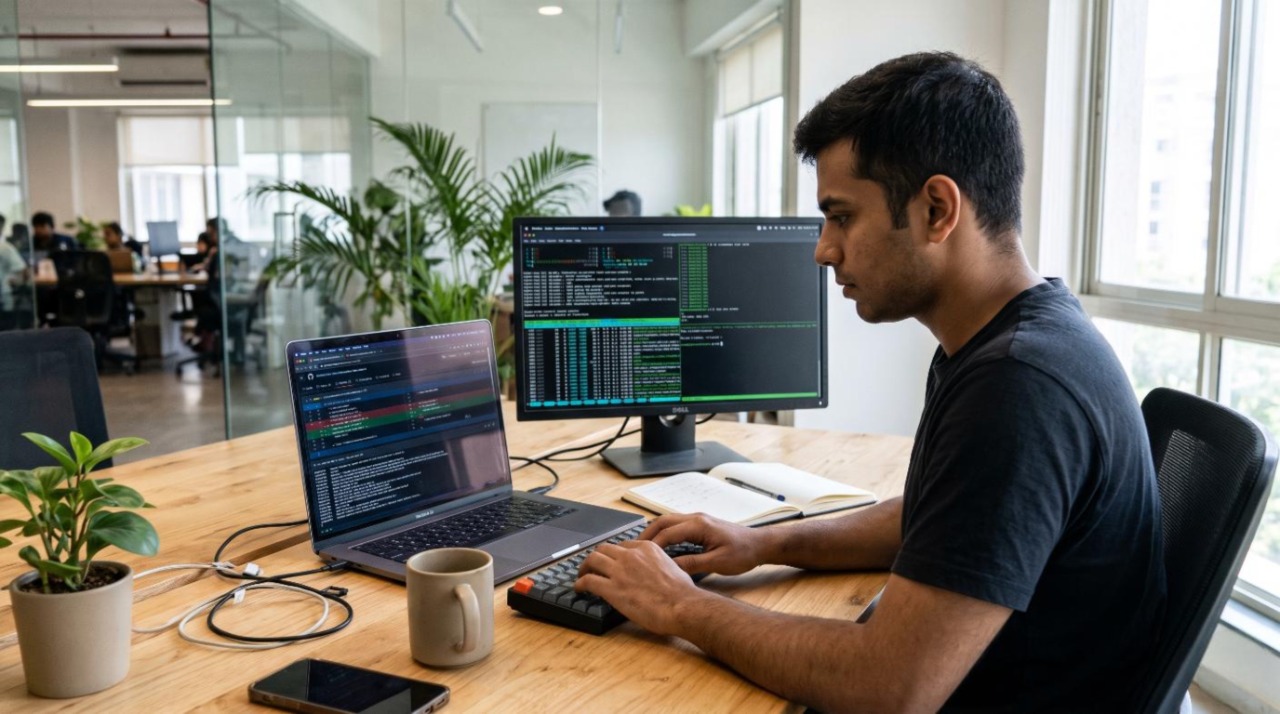
Pairing visual pull-request diffs inside an AI editor with terminal-driven agent runs during multi-file engineering reviews.
1) CURSOR (Interactive AI-Native IDE)
   Developer in VS Code Fork -> Tab Autocomplete + Inline Diffs + Bugbot -> Grok Pool / API Third-Party Models

2) CLAUDE CODE (Terminal-First Agent Harness)
   Developer in Terminal / CI -> Local Repo Read/Grep/Bash + PreToolUse Hooks -> Anthropic / Bedrock / Vertex

3) OPENAI CODEX (Cross-Surface Delegated Agent)
   CLI / IDE / ChatGPT Desktop / Cloud -> Sandboxed Workspace (No Net by Default) -> GPT-6.2 Sol & Astra
When Cursor Wins
Cursor remains the fastest environment for frontend, Next.js, and full-stack product engineers who rely on visual diffs, component previews, and rapid tab-completion loops. Its Premium ($30/mo) tier adds Cloud Agents, Bugbot AI pull-request reviews, Origin code hosting, and Grok 4.7 access, while Plus ($8/mo, ~₹696/mo) is the lowest-cost paid AI editor tier for solo Indian developers comfortable working with Cursor and Grok models. If you are modernizing a frontend stack alongside AI tooling, pair this workflow with our Web Dev Trends 2026: 15 Production Stack Shifts (Next.js) and Next.js SEO Guide (2026).
When Claude Code Wins
Claude Code excels at repository-wide refactoring, backend architecture audits, and regulated enterprise deployments. Because Anthropic lets you route Claude Code directly through Amazon Bedrock, Google Vertex AI, or Microsoft Azure Foundry, enterprises with existing cloud commitments and strict VPC data residency rules can deploy Claude Code without onboarding a separate shadow-AI vendor. Its deterministic PreToolUse permission hooks also align directly with production governance patterns covered in AI Agents in 2026: Architecture, MCP & 6 B2B Use Cases.
When OpenAI Codex Wins
OpenAI Codex wins asynchronous ticket delegation, CI/CD GitHub Actions automation, and cost-sensitive scale. Because ChatGPT Business Standard ($20/seat/mo annual) bundles both ChatGPT Work and Codex—and GPT-6.2 Sol delivers near-flagship coding quality at $2/$10 per million tokens with a 95% prompt-cache discount—engineering teams capture high autonomous throughput at the lowest base seat cost.
Real 10-Developer Team Annual Budget (USD & INR)
Sticker prices per seat mislead engineering managers because overages, third-party API pass-throughs, and mixed heavy-user tiers change the true annual invoice. Below is the verified base subscription math for a 10-developer team (excluding third-party API overages and applicable GST/VAT; indicative INR calculated at ₹87/USD):
| 10-Developer Team Configuration (Nov 2026 List Rates) | Monthly Total (USD) | Annual Total (USD) | Indicative Annual (INR) | Hidden Cost Lever to Watch |
|---|---|---|---|---|
| Cursor Teams — All 10 Premium ($30/seat) | $300 | $3,600 | ~₹3.13 Lakh | Claude/3rd-party API usage billed extra + $0.25/M Token Rate |
| Cursor Teams — 8 Premium + 2 Super ($30 / $100) | $440 | $5,280 | ~₹4.59 Lakh | Weekly pools do not transfer across team members |
| Claude Code Team — All 10 Standard Annual ($20/seat) | $200 | $2,400 | ~₹2.09 Lakh | Rolling 5-hr + weekly caps; agent teams burn ~7x normal tokens |
| Claude Code Team — 8 Std ($20) + 2 Prem ($100) Annual | $360 | $4,320 | ~₹3.76 Lakh | Upgrade only heavy CLI/refactor leads to Premium seats |
| OpenAI Codex (Business) — All 10 Std Annual ($20/seat) | $200 | $2,400 | ~₹2.09 Lakh | Set workspace credit caps; monthly billing adds $5/seat ($3,000/yr) |
| OpenAI Codex (Business) — 8 Std + 2 Prem Annual | $360 | $4,320 | ~₹3.76 Lakh | Premium seats unlock 5x usage & remove 5-hour caps |
For organizations comparing developer productivity seats against building custom internal AI engineering agents, cross-reference these figures with our AI Agent Cost in India (2026): ₹1.5L–₹35L Pricing + ROI and Custom AI Cost in India (2026): ₹1.2L–₹40L Breakdown.
4 Hidden Cost Traps That Blow Up AI Coding Budgets
Audit Overage Rules Before Rolling Out Seats: Across all three vendors, overage mechanics—not base subscription prices—cause 70%+ of surprise invoices. Check these four billing traps in week one.
- Cursor's $0.25/M Token Rate Surcharge (Even on BYOK): On Cursor Teams and Enterprise, eligible third-party model requests incur an extra $0.25 per million tokens across input, output, and cached tokens—and per Cursor's documentation, this surcharge applies even when you bring your own API key (BYOK).
- GPT-6.2's 272K Long-Context Cliff & Ultrafast Multipliers: On the OpenAI API, crossing 272,000 input tokens reprices the entire request at 2x input/cache and 1.5x output—pushing GPT-6.2 Sol from $2/$10 to $4/$15 and GPT-6.2 Astra from $8/$40 to $16/$60. Likewise, Fast mode bills at 2x and Ultrafast bills at 3x through February 28, 2027 (rising to 6x on March 1, 2027).
- Claude Code's Multi-Agent Token Multiplier & Haiku 100K Step-Up: Running parallel Claude Code agent teams in plan mode consumes roughly 7x more tokens than single-session coding, while Claude Haiku 5.5 jumps from $0.10/$0.50 to $0.50/$2.50 above 100K prompt tokens.
- Uncapped Cloud & Background Automation Runs: Always configure hard workspace spend limits in the Anthropic Console, OpenAI Business credit pool, and Cursor Admin dashboard before enabling automated PR review bots or scheduled cloud agents.
6 Concrete Ways to Cut Your AI Coding Bill by 50%+
Engineering teams can keep top-tier velocity while cutting monthly token burn in half with six operational habits:
- Adopt the "Hybrid $28–$40/Month" Developer Stack: Pair Cursor Plus ($8/mo) or VS Code + Copilot for fast visual editing with Claude Pro ($20/mo) or ChatGPT Plus / Codex ($20/mo) for heavy multi-file terminal refactors—avoiding $100–$200 single-vendor tiers until you consistently hit weekly caps.
- Route by Model Tier (Planner vs. Executor): Use GPT-6.2 Sol ($2/$10), Claude Sonnet 5.5 ($2/$10), or Grok 4.7 ($2/$6) for 85% of feature work, reserving GPT-6.2 Astra ($8/$40) and Claude Fable 5.2 ($8/$40) strictly for hard architecture bugs and security reviews. Route simple subagents to Claude Haiku 5.5 ($0.10/$0.50) or GPT-6.1 Terra ($1/$5).
- Exploit Prompt Caching (Up to 95% Input Savings): Keep static repository instructions at the top of your system prompt and avoid changing prefixes mid-session. On GPT-6.2 Sol and Claude Sonnet 5.5, cached input drops from $2.00 to $0.10 per million tokens (and on GPT-6.2 Astra, from $8.00 to $0.40).
- Clear Context Between Unrelated Tickets: Run
/clearin Claude Code (or start fresh threads in Cursor/Codex) whenever switching features, and keepCLAUDE.md/.cursorrulesconcise so you aren't paying to re-send 15,000 irrelevant tokens on every turn. - Dial Down Reasoning Effort on Routine Edits: Use
/effortcontrols or Light/Medium reasoning presets for CSS tweaks, unit test scaffolding, and boilerplate—reasoning tokens bill at output rates (5x input). - Prune Idle MCP Servers: Disconnect unused MCP tools in your editor/CLI config. Every active MCP server injects tool JSON schemas into every model call; prefer lightweight native CLI tools (
gh,git,psql) when a full MCP server isn't needed.
Enterprise Security & Procurement Checklist (Post-Cursor Split)
The August–November 2026 Cursor–OpenAI contract dispute proved that AI coding tools carry real upstream model supply-chain risk, while both Cursor (DuneSlide sandbox escape) and Codex CLI (CVE-2025-61260) patched critical CVSS 9.8 vulnerabilities over the past year. Before approving company-wide rollout:
- Enforce Sandboxed Execution & Egress Allowlists: Keep local shell commands locked inside workspace-write sandboxes with outbound network disabled unless explicitly approved, and harden production repos against indirect prompt injection via malicious PR comments, issues, or dependencies—following our AI Agent Security (2026): 7 Prompt Injection Defenses and Website Security Checklist 2026.
- Negotiate Procurement Escape Hatches: On Enterprise contracts, require explicit model-availability clauses, change-of-control termination rights, and clean BYOK/cloud-gateway fallback so an upstream lab dispute cannot stall your engineering org mid-year.
- Avoid Single-Vendor Lock-In Across Your Automation Stack: Keep project rules in portable Markdown (
AGENTS.md/CLAUDE.md) and evaluate broader operational workflows with our Small Business AI Automation (2026): Demand & 25 ROI Flows.
Decision Matrix: Which AI Coding Tool Should You Buy Right Now?
| Developer / Organization Profile | Recommended Setup (Nov 2026) | Estimated Cost | Why It Wins |
|---|---|---|---|
| Budget solo dev / student in India | Cursor Plus (or ChatGPT Go + Free VS Code) | $8/mo (~₹696/mo) | Cheapest paid AI-native coding pool with Grok 4.7 access |
| Daily full-stack / Next.js product engineer | Cursor Premium (or Hybrid: Cursor Plus + Claude Pro) | $28–$30/mo (~₹2,436–₹2,610/mo) | Best visual diffs + Tab flow without $100 tier lock-in |
| Senior backend / DevOps / monorepo engineer | Claude Code Pro/Max or Codex Plus/Pro 100 | $20–$100/mo | Superior deep-repo terminal workflows and scripted automation |
| 10–50 dev SaaS startup (cost-optimized) | ChatGPT Business Std (Codex) or Claude Team Std | $20/seat/mo annual | Lowest base team rate ($2,400/yr for 10 devs) + strong models |
| Regulated enterprise (AWS / GCP / Azure) | Claude Code on Bedrock / Vertex / Foundry | API + $20/seat | Keeps billing, IAM, and data residency inside existing cloud VPC |
Frequently Asked Questions
Is Cursor Pro still $20 a month in late 2026?
No. In October 2026, Cursor retired its legacy $20 Pro, $60 Pro+, and ₹649 India Start plans and moved into The X Subscription lineup: Free ($0), Plus ($8/month, Grok/Cursor models only), Premium ($30/month), Super ($100/month), Ultra ($200/month), and Teams ($30–$200/user/month), with third-party models like Claude billed separately at API list prices.
Did OpenAI permanently cut off Cursor in November 2026?
Following SpaceX's acquisition of Cursor in August 2026, OpenAI notified SpaceX it would wind down its model contract with a proposed shutoff date of November 12, 2026. On November 12, 2026, OpenAI published an update confirming it had temporarily extended Cursor's access beyond November 12 while transition arrangements continue. Even if bundled access ends, teams can stay on Cursor using Grok/Claude models or direct OpenAI API contracts, or move OpenAI-heavy workflows to Codex.
Which AI coding tool is the best value in India right now?
For solo developers on a tight budget, Cursor Plus at $8/month (~₹696/month before GST) is the lowest-cost paid AI editor tier (using Cursor/Grok models). For frontier Claude or GPT-6.2 Sol coding quality, Claude Pro ($17/month annual, ~₹1,479/month) and ChatGPT Plus with Codex ($20/month, ~₹1,740/month) deliver the strongest price-to-performance ratio.
Does Claude Code have a free tier?
No. Unlike Cursor Free and ChatGPT/Codex Free, the Free Claude plan does not include Claude Code. The lowest entry point is Claude Pro ($20/month or $17/month annual) or pay-per-token billing via an Anthropic Console API key (or AWS Bedrock / Google Vertex AI).
Which is better on real coding benchmarks: Cursor, Claude Code, or Codex?
On Terminal-Bench 4.0, the top Codex and Claude Code configurations are in a statistical tie (58.2% ±2.8% vs. 57.9% ±3.8%), meaning neither holds a decisive raw intelligence lead. However, Codex completed the full benchmark suite at roughly half the token cost ($3.3K vs. $6.2K), while Cursor excels in interactive visual editing speed inside VS Code.
What is the Cursor Token Rate surcharge?
On Cursor Teams and Enterprise plans, eligible third-party model calls incur an extra $0.25 per million tokens across input, output, and cached tokens—even if you configure your own API key (BYOK). Cursor's own models and Cost mode requests are exempt.
Should an engineering team standardize on one tool or run a hybrid stack?
Most high-performing engineering teams in late 2026 run a hybrid setup: pairing a visual AI editor (like Cursor Plus/Premium or VS Code) for day-to-day UI and interactive coding with a terminal/cloud agent (Claude Code or OpenAI Codex) for automated test generation, migrations, and CI pull-request reviews.
Conclusion and Next Steps
With top AI coding agents now statistically tied on benchmark capability, winning teams in late 2026 stop chasing minor leaderboard swings and optimize for total cost per shipped PR, sandbox security, and vendor resilience. Audit your real token burn, cap cloud-agent spend, and choose the workflow surface—IDE, terminal, or cloud—that fits how your engineers actually ship software.
Continue exploring Zenvira's engineering guides: AI Agents in 2026: Architecture, MCP & 6 B2B Use Cases, AI Agent Security (2026): 7 Prompt Injection Defenses, AI Agent Cost in India (2026): ₹1.5L–₹35L Pricing + ROI, and Web Dev Trends 2026: 15 Production Stack Shifts (Next.js).
Need senior architects to build custom AI coding workflows, hardened enterprise AI agents, or high-velocity Next.js SaaS platforms? Explore Zenvira's AI Agents & Automation services, review our Web & App Engineering practice and Cybersecurity services, or book a technical consultation.